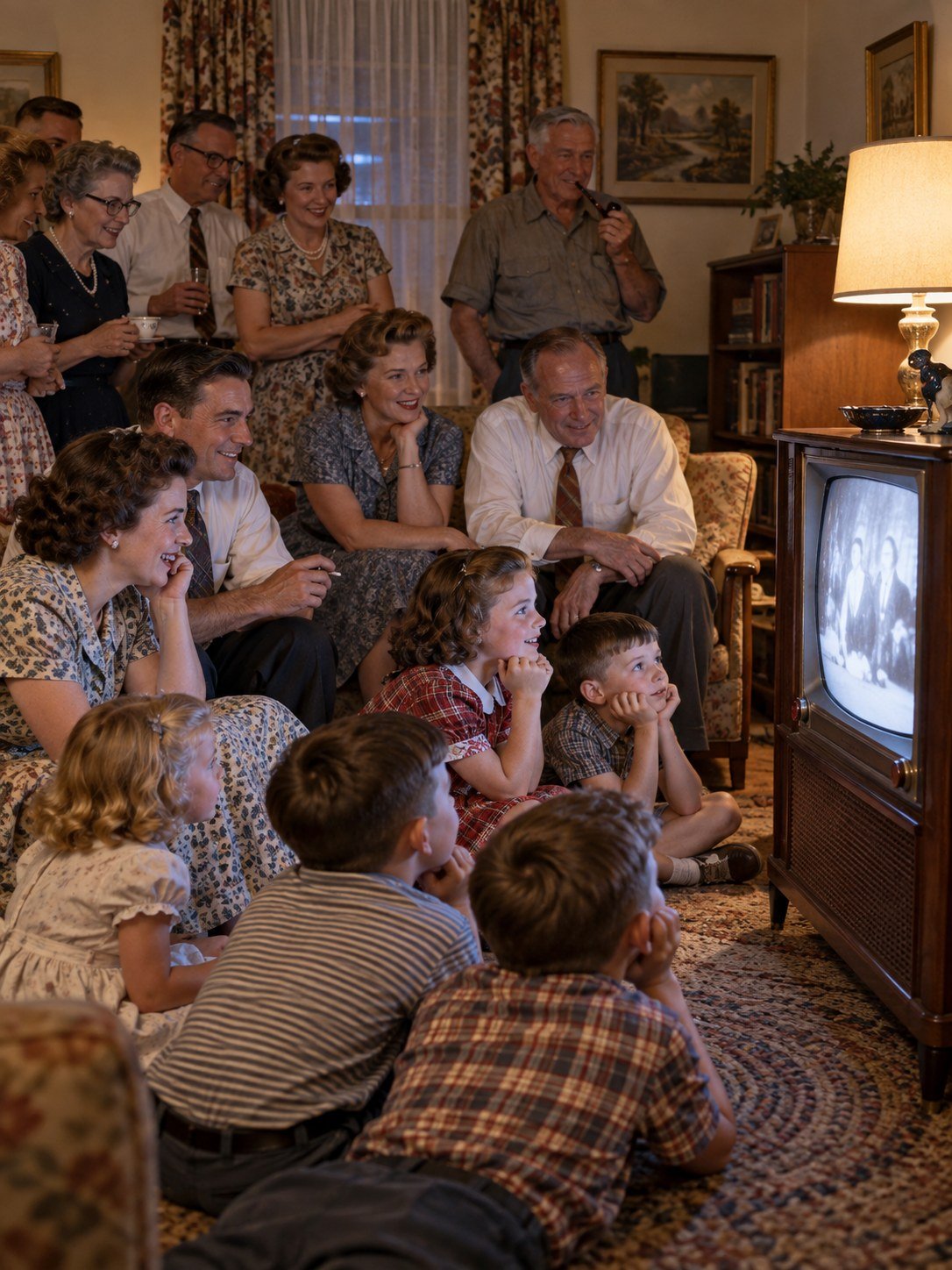
As television ownership expanded in postwar America, the first set on a block often attracted relatives and neighbors who had not yet purchased one. The detail feels surprising today because the scale and rhythm of ordinary American life have changed so dramatically. A single surviving object can make that transformation easier to see than a page of abstract numbers.
The bulky cabinet and small screen became both appliance and event, rearranging furniture before a program even began. For many older readers, one sound, smell, or texture can bring back a room more vividly than a formal history lesson. Older witnesses often remember the surrounding routine first, then recover dates by comparing family records.
In this reconstruction, the Harris family schedules a Saturday viewing and invites Maple Street to bring folding chairs and dessert. To understand it fairly, the object has to be placed back inside the wages, expectations, and limitations of its own time. Household practices were learned through repetition, with children watching adults solve problems using what was available.
Children sit on the rug while adults adjust an antenna and debate whether a snowy picture counts as clear reception. Prices may look tiny on paper, but purchasing power and household budgets made every dollar carry far more weight. Those lessons could travel across generations even after the original economic reason had disappeared.
Early broadcasts offered fewer channels and limited hours compared with later television, so viewers often gathered around the same programs. The surviving clue does not tell an entire life story, but it opens a useful window onto a world many families remember. Local newspapers, receipts, directories, photographs, and oral histories can confirm parts of a recollection while correcting others.
Shared scarcity gave Monday conversations a common reference even among households with different routines. Families adapted with thrift, shared labor, and habits that made sense long before convenience became an expectation. The most honest account leaves uncertainty visible rather than inventing precision where the record remains incomplete.
The host family gains new social responsibilities: controlling volume, deciding what children may watch, and handling guests who arrive without warning. What appears quaint in hindsight was usually a practical response to cost, distance, technology, or social custom. Workers who made the system function are often missing from nostalgic images centered only on customers or families.
A television expands the living room beyond the household while also giving one family unusual influence over the evening. The same custom could create warmth for one person and pressure for another, which is why memory deserves nuance. Naming their labor restores complexity to scenes that can otherwise look effortless from a distance of decades.
Advertising enters homes with vivid demonstrations of products, lifestyles, and expectations that reshape consumer desire. The practice varied by region and household, so no single recollection can represent every American experience. Economic opportunity expanded unevenly, and access depended heavily on geography, race, gender, disability, and family resources.
The screen offers entertainment and information while encouraging viewers to compare their possessions with carefully constructed images. Everyday systems often depended on trust between neighbors and on work performed quietly behind the scenes. That unevenness belongs inside the story even when the remembered object inspires affection.
News events become visual, bringing distant ceremonies, conflicts, and public figures into rooms that previously relied more heavily on radio, newspapers, and newsreels. Even so, repeated memories and surviving objects reveal patterns that official statistics alone rarely capture. Technological change usually arrived gradually, so old and new systems operated side by side for years.
Seeing events together can intensify both understanding and emotion. Modern replacements solved real problems, yet they also removed small rituals that once brought people face to face. Families adopted new conveniences at different speeds according to cost, trust, availability, and personal preference.
Not every response is enthusiastic; some adults worry conversation will disappear, children will neglect homework, and families will stop visiting one another. The human meaning becomes clearest when we notice who performed the work, who benefited, and who was overlooked. An oral-history interview can preserve gestures and vocabulary that written records rarely capture on their own.
Those concerns prove partly justified, though early neighborhood viewing initially creates more gathering rather than less. Listening to firsthand memories helps preserve texture while records provide the dates, costs, and wider context. Dates and prices become more meaningful when paired with the feelings people attached to an ordinary day.
As additional families buy sets, crowds on Maple Street shrink and television changes from a communal novelty into a private household habit. That context separates honest nostalgia from the tempting idea that every part of the past was simpler or better. Museum preservation protects material evidence, but family storytelling explains why anyone cared enough to save it.
Convenience increases while the accidental weekly meeting gradually ends. A responsible look backward can honor resilience without ignoring exclusion, hardship, or unequal opportunity. Both forms of memory are strongest when they acknowledge disagreement instead of forcing one polished version.
Older residents later remember the first screen as tiny and unreliable, yet recall the room around it as enormous because nearly everyone they knew was present. The fragment matters because it connects a private memory to a much larger period of national change. The past did not move in a straight line from hardship to comfort; gains often introduced new costs and dependencies.
The technology’s emotional scale came from the crowd, not the inches measured diagonally. That balance is what turns nostalgia into history rather than allowing sentiment to stand in for evidence. Seeing that tradeoff helps readers compare eras without reducing either one to a slogan.
Today, individual screens deliver unlimited choices, making the single shared program difficult to imagine. Preserving such details gives younger readers a way to ask better questions of the people who lived through them. The fragment encourages families to label photographs, scan fragile papers, and record voices while questions can still be answered.
The day television arrived matters because it captures a brief transition when a new medium brought an entire neighborhood together before helping each household watch separately. The object survives as more than a collectible; it becomes a prompt for families to record their own versions now. Future historians may depend on those small acts of care to understand how daily life actually felt. This article is an original historical reconstruction: its specific family scene is illustrative, while the period practices are presented as historical context rather than a claim about archival individuals.