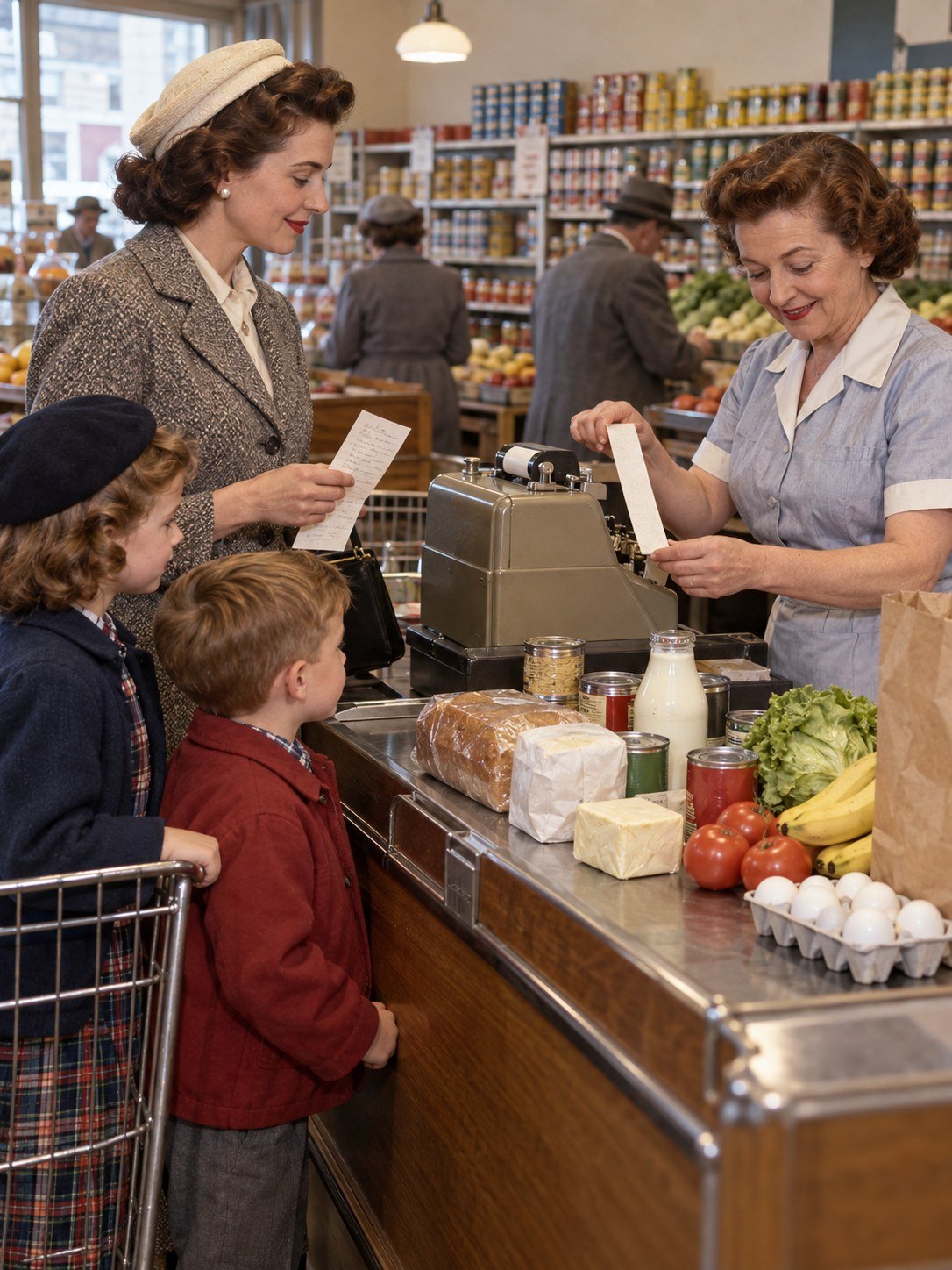
This reconstruction begins with staples such as flour, cornmeal, oats, beans, potatoes, seasonal produce, milk, eggs, and modest cuts of meat. The scene is presented as a representative reconstruction, not as a claim that one pictured household speaks for every place or family. In a neighborhood grocery counter in 1957, the detail that keeps drawing attention is a penciled grocery list and narrow paper receipt.
A fair reading avoids treating the past as either perfectly simple or uniformly harsh. The useful question is what the routine solved, what it demanded, and whose work made it possible. Seen through an illustrative family of six balancing a weekly food budget, the moment gains a human scale and avoids turning a complicated experience into a slogan or a single dramatic image.
Any comparison with modern prices must account for wages, package sizes, regional differences, taxes, quality, and the share of income food required. Materials, cost, access, and custom vary by region and decade, but the routine is recognizable across many recorded memories of the period. In a neighborhood grocery counter in 1957, the detail that keeps drawing attention is a penciled grocery list and narrow paper receipt.
Household history often survives at the scale of the hand: a fold, a stain, a worn handle, or a penciled number. Those details can reveal behavior that official summaries miss. Seen through an illustrative family of six balancing a weekly food budget, the moment gains a human scale and avoids turning a complicated experience into a slogan or a single dramatic image.
A low receipt total may exclude vegetables from a garden, preserved fruit, a neighbor’s eggs, or pantry goods purchased in an earlier week. What looks quaint from a distance usually depends on repeated labor that advertisements and family snapshots rarely place at the center. In a neighborhood grocery counter in 1957, the detail that keeps drawing attention is a penciled grocery list and narrow paper receipt.
Price comparisons alone cannot explain the experience. Wages, time, package size, durability, family structure, and access all change what an apparently small number meant. Seen through an illustrative family of six balancing a weekly food budget, the moment gains a human scale and avoids turning a complicated experience into a slogan or a single dramatic image.
Families often plan several meals around one roast or chicken, carrying leftovers into sandwiches, soup, gravy, and casseroles. Children often remember the sounds, textures, smells, and adult instructions more clearly than the economic system surrounding the routine. In a neighborhood grocery counter in 1957, the detail that keeps drawing attention is a penciled grocery list and narrow paper receipt.
The routine also shaped relationships. Neighbors, clerks, drivers, repair workers, and relatives exchanged information and help through systems that were less anonymous than many modern equivalents. Seen through an illustrative family of six balancing a weekly food budget, the moment gains a human scale and avoids turning a complicated experience into a slogan or a single dramatic image.
Scratch cooking transfers cost from the checkout counter to the kitchen, where somebody spends time kneading, peeling, soaking, canning, and cleaning. The practice connects household choices to shops, routes, workers, infrastructure, and rules extending far beyond the room where it is remembered. In a neighborhood grocery counter in 1957, the detail that keeps drawing attention is a penciled grocery list and narrow paper receipt.
Familiarity could create trust, but it could also expose private hardship or reinforce unequal treatment. Both sides belong in an honest account of everyday life. Seen through an illustrative family of six balancing a weekly food budget, the moment gains a human scale and avoids turning a complicated experience into a slogan or a single dramatic image.
Children may carry lunches in reusable boxes while adults bring thermoses to work, reducing purchased meals but increasing preparation at home. Its advantages are real, yet so are its limits; nostalgia becomes more useful when convenience, risk, exclusion, and unpaid work remain visible. In a neighborhood grocery counter in 1957, the detail that keeps drawing attention is a penciled grocery list and narrow paper receipt.
Newer systems usually gained ground for practical reasons such as safety, speed, labor savings, affordability, or scale. Remembering what disappeared does not require rejecting what improved. Seen through an illustrative family of six balancing a weekly food budget, the moment gains a human scale and avoids turning a complicated experience into a slogan or a single dramatic image.
Credit at a neighborhood store can bridge payday, though running a tab also creates stress and depends on the grocer’s knowledge of local households. The change does not happen everywhere at once. New technology overlaps with older habits as families adopt it according to income and local availability. In a neighborhood grocery counter in 1957, the detail that keeps drawing attention is a penciled grocery list and narrow paper receipt.
At the same time, progress can exchange repair, reuse, or personal knowledge for convenience. The tradeoff becomes visible only when the old process is described in full. Seen through an illustrative family of six balancing a weekly food budget, the moment gains a human scale and avoids turning a complicated experience into a slogan or a single dramatic image.
Advertising images of abundant mid-century tables often hide food insecurity, unequal access, and the labor expected primarily from women. Once the routine disappears, the tools often remain in basements, drawers, albums, or museums without the instructions that once made them understandable. In a neighborhood grocery counter in 1957, the detail that keeps drawing attention is a penciled grocery list and narrow paper receipt.
Preserving tools without stories creates silent displays. Names, voices, instructions, and conflicting memories turn an artifact back into evidence of lived experience. Seen through an illustrative family of six balancing a weekly food budget, the moment gains a human scale and avoids turning a complicated experience into a slogan or a single dramatic image.
A preserved receipt is most useful when paired with oral history explaining where the food came from and how many meals it actually produced. Oral histories add the missing human detail, especially when several people remember the same custom differently because their responsibilities were different. In a neighborhood grocery counter in 1957, the detail that keeps drawing attention is a penciled grocery list and narrow paper receipt.
The strongest family archive therefore pairs the object with dates, places, and accounts from people who performed the work rather than only those who watched it. Seen through an illustrative family of six balancing a weekly food budget, the moment gains a human scale and avoids turning a complicated experience into a slogan or a single dramatic image.
The weekly total remains fascinating, but the fuller lesson is that feeding six people required a system of money, time, skill, reuse, and community support. Seen in context, the surviving object becomes evidence of how people organized time, money, care, and community with the systems available to them. In a neighborhood grocery counter in 1957, the detail that keeps drawing attention is a penciled grocery list and narrow paper receipt.
That context keeps nostalgia from flattening history. It lets a familiar item carry affection while still revealing labor, limits, adaptation, and unequal access. Seen through an illustrative family of six balancing a weekly food budget, the moment gains a human scale and avoids turning a complicated experience into a slogan or a single dramatic image. This article uses an illustrative reconstruction grounded in broadly documented period practices; the pictured people and household are not presented as a specific archival record.