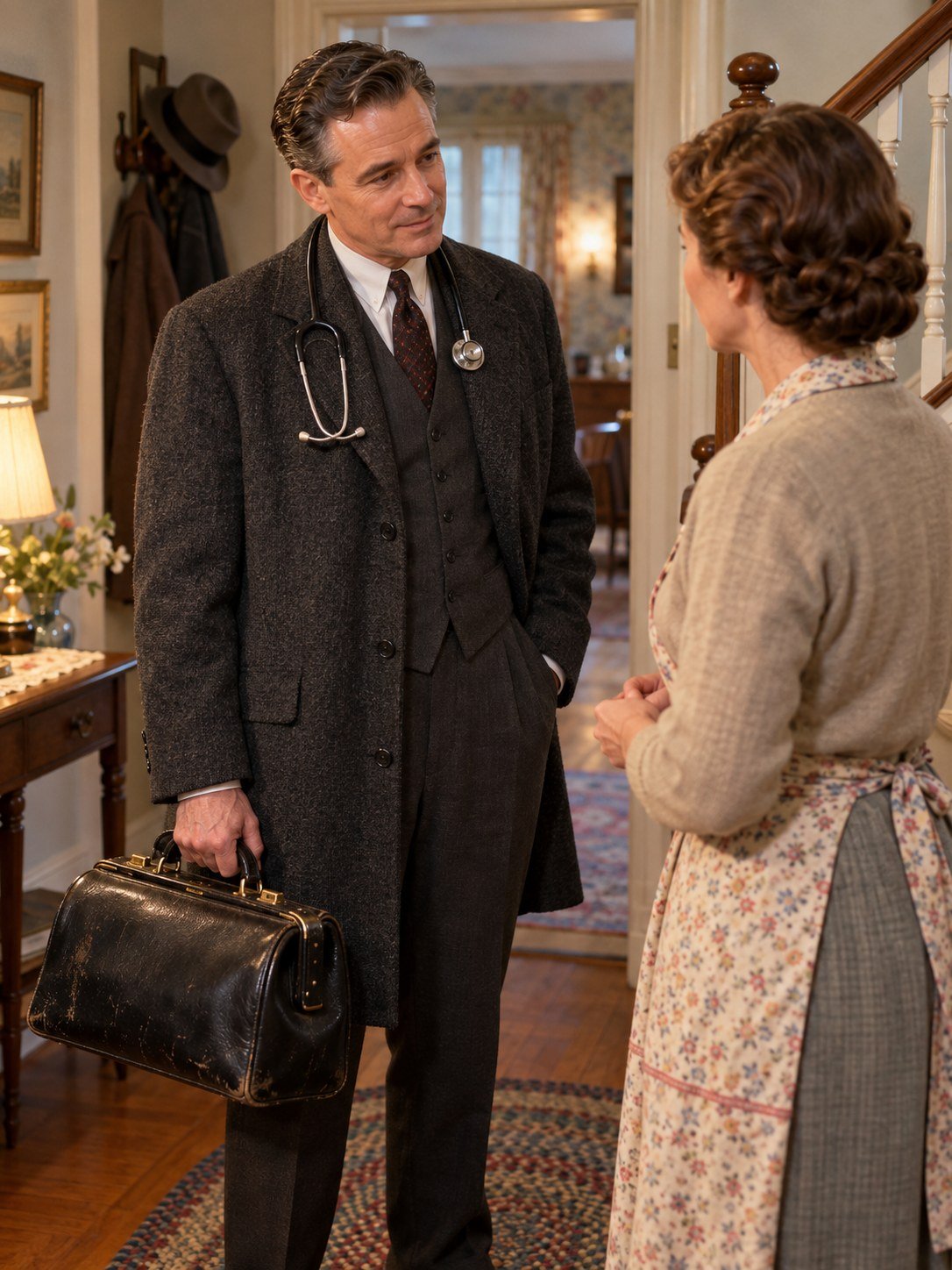
In this reconstruction, a family phones a local physician after a child’s fever rises and waits for a visit after the doctor’s office closes. The scene is presented as a representative reconstruction, not as a claim that one pictured household speaks for every place or family. In a small family bedroom during a winter illness, the detail that keeps drawing attention is a worn black doctor’s bag beside the bed.
A fair reading avoids treating the past as either perfectly simple or uniformly harsh. The useful question is what the routine solved, what it demanded, and whose work made it possible. Seen through a neighborhood physician and the families on a mid-century route, the moment gains a human scale and avoids turning a complicated experience into a slogan or a single dramatic image.
House calls allow the physician to see living conditions, family dynamics, heating, food, and other details that an examination room can conceal. Materials, cost, access, and custom vary by region and decade, but the routine is recognizable across many recorded memories of the period. In a small family bedroom during a winter illness, the detail that keeps drawing attention is a worn black doctor’s bag beside the bed.
Household history often survives at the scale of the hand: a fold, a stain, a worn handle, or a penciled number. Those details can reveal behavior that official summaries miss. Seen through a neighborhood physician and the families on a mid-century route, the moment gains a human scale and avoids turning a complicated experience into a slogan or a single dramatic image.
The black bag may contain a stethoscope, thermometer, bandages, basic instruments, and selected medicines, but it cannot replace modern diagnostic equipment. What looks quaint from a distance usually depends on repeated labor that advertisements and family snapshots rarely place at the center. In a small family bedroom during a winter illness, the detail that keeps drawing attention is a worn black doctor’s bag beside the bed.
Price comparisons alone cannot explain the experience. Wages, time, package size, durability, family structure, and access all change what an apparently small number meant. Seen through a neighborhood physician and the families on a mid-century route, the moment gains a human scale and avoids turning a complicated experience into a slogan or a single dramatic image.
Familiarity can build trust because the doctor knows siblings and prior illnesses, though memory and personal judgment may also introduce blind spots. Children often remember the sounds, textures, smells, and adult instructions more clearly than the economic system surrounding the routine. In a small family bedroom during a winter illness, the detail that keeps drawing attention is a worn black doctor’s bag beside the bed.
The routine also shaped relationships. Neighbors, clerks, drivers, repair workers, and relatives exchanged information and help through systems that were less anonymous than many modern equivalents. Seen through a neighborhood physician and the families on a mid-century route, the moment gains a human scale and avoids turning a complicated experience into a slogan or a single dramatic image.
Payment arrangements differ widely, with some families using cash, insurance, delayed bills, or informal exchanges in rural communities. The practice connects household choices to shops, routes, workers, infrastructure, and rules extending far beyond the room where it is remembered. In a small family bedroom during a winter illness, the detail that keeps drawing attention is a worn black doctor’s bag beside the bed.
Familiarity could create trust, but it could also expose private hardship or reinforce unequal treatment. Both sides belong in an honest account of everyday life. Seen through a neighborhood physician and the families on a mid-century route, the moment gains a human scale and avoids turning a complicated experience into a slogan or a single dramatic image.
Access is never universal; distance, race, poverty, disability, and the availability of physicians shape who receives a home visit and how quickly. Its advantages are real, yet so are its limits; nostalgia becomes more useful when convenience, risk, exclusion, and unpaid work remain visible. In a small family bedroom during a winter illness, the detail that keeps drawing attention is a worn black doctor’s bag beside the bed.
Newer systems usually gained ground for practical reasons such as safety, speed, labor savings, affordability, or scale. Remembering what disappeared does not require rejecting what improved. Seen through a neighborhood physician and the families on a mid-century route, the moment gains a human scale and avoids turning a complicated experience into a slogan or a single dramatic image.
As hospitals, clinics, specialization, insurance systems, and technology expand, routine house calls decline across much of the United States. The change does not happen everywhere at once. New technology overlaps with older habits as families adopt it according to income and local availability. In a small family bedroom during a winter illness, the detail that keeps drawing attention is a worn black doctor’s bag beside the bed.
At the same time, progress can exchange repair, reuse, or personal knowledge for convenience. The tradeoff becomes visible only when the old process is described in full. Seen through a neighborhood physician and the families on a mid-century route, the moment gains a human scale and avoids turning a complicated experience into a slogan or a single dramatic image.
The office model increases access to equipment and staff but asks sick patients and caregivers to travel, wait, and navigate less personal systems. Once the routine disappears, the tools often remain in basements, drawers, albums, or museums without the instructions that once made them understandable. In a small family bedroom during a winter illness, the detail that keeps drawing attention is a worn black doctor’s bag beside the bed.
Preserving tools without stories creates silent displays. Names, voices, instructions, and conflicting memories turn an artifact back into evidence of lived experience. Seen through a neighborhood physician and the families on a mid-century route, the moment gains a human scale and avoids turning a complicated experience into a slogan or a single dramatic image.
Modern home health and concierge services revive parts of the old model, although under very different rules, costs, and clinical standards. Oral histories add the missing human detail, especially when several people remember the same custom differently because their responsibilities were different. In a small family bedroom during a winter illness, the detail that keeps drawing attention is a worn black doctor’s bag beside the bed.
The strongest family archive therefore pairs the object with dates, places, and accounts from people who performed the work rather than only those who watched it. Seen through a neighborhood physician and the families on a mid-century route, the moment gains a human scale and avoids turning a complicated experience into a slogan or a single dramatic image.
Remembering the house call honestly means holding both truths: personal attention could be extraordinary, and the medicine available at home was often limited. Seen in context, the surviving object becomes evidence of how people organized time, money, care, and community with the systems available to them. In a small family bedroom during a winter illness, the detail that keeps drawing attention is a worn black doctor’s bag beside the bed.
That context keeps nostalgia from flattening history. It lets a familiar item carry affection while still revealing labor, limits, adaptation, and unequal access. Seen through a neighborhood physician and the families on a mid-century route, the moment gains a human scale and avoids turning a complicated experience into a slogan or a single dramatic image. This article uses an illustrative reconstruction grounded in broadly documented period practices; the pictured people and household are not presented as a specific archival record.



